
United Diamond Tools - Suppling Blades across Australia from Perth WA    
 
HOW TO CHOOSE
SAFETY
WHERE TO BUY
CONTACT US
   
 
Diamond Blades For:
Asphalt
Clay Pavers
Concrete
Concrete Pavers
Limestone Pavers
Core Barrels
Electroplated Blades
Wall Chasing Blades
 
Diamond tool Hire
Contact UDT

United Diamond Tools
Suppling Diamond Blades across
Australia from Perth WA


Miguel Rd (Cnr Barrington Rd)
Bibra Lake, Perth 6163
Tel: (08) 9418 8913


DIAMOND BLADES - What are they?


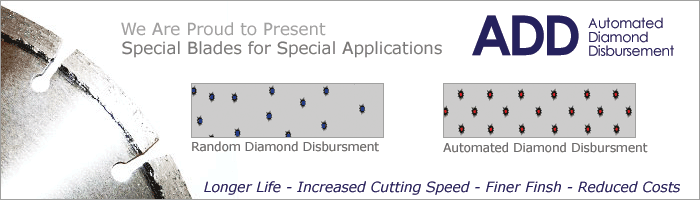
Diamond blades are made up of:

Diamond crystals
These are the cutting agents and come in different grit sizes, quality and quantity

Bonding system
Bonding systems hold the diamond crystals and play important roles:
- Support the diamonds
- Allow the diamond to protrude by controlled wear to allow the blade to have a continual
refreshment of the cutting edge
- Prevents the diamond dropping out until ready
- Acts as an absorbent heat sink
- Allows control of impact and load as the diamonds grind and cut the product
- Correct bonding systems for the product being cut extends the life of the blade

Segments
These are a combination of crystals and bonding agent that are manufactured into segments
that are wider than the steel core to provide clearance while cutting. These segments vary in
diamond concentration and strength of bond. Generally softer bonds are used for harder product
being cut and harder bonds for softer products.

Steel core
The segments are attached to a steel disc that are tensioned at the manufacturing stage and
have gullets(or slots) to provide increased cooling by the introduction of air or water flow.
It is important that the steel cores are flexible enough to allow flexing of the blade while under
cutting pressure. An arbor hole is positioned in the centre of the bade and can vary in size to
suit specific machines.


HOW DO DIAMOND BLADES WORK?


Diamond blades grind their way through the substance to be cut.


There are diamond crystals exposed on the edges and sides of the segments encased in their
"bond" and these exposed diamond crystals do the grinding work as the blade rotates on the
arbor of the machine.

The bond locks each crystal in place and behind each diamond crystal there is a tail of bond that
helps support the diamond segment and lock it in place. The grinding process causes the
substance being cut to be converted into a fine powder, while the bond also wears away
exposing more diamonds to complete the work.

As the substance wears away the bond, the diamond crystals crack and fracture into tiny pieces
that also assist in the grinding process. Harder materials break down the diamond structure
faster, requiring more concentrated array of diamonds in the bond. This continuous grinding and
wearing process continues until the blade is "worn out" although sometimes a small, unusable
part of the segments or rim may remain.

It is important to understand that the diamond blade and the material must work together
(or interact) for the blade to cut effectively. The diamond type, quality and grit size must be
suited for the saw and the material. The bond material must also be matched to the material to
be cut.


DIAMOND BLADE TROUBLESHOOTING

Problem
Probable Causes
Solutions
Diamond Blade Will Not Cut
Diamond Blade is too hard for material being cut Select proper specification for material being cut
Diamond Blade had become dull as a result of being used on hard material Dress with abrasive material until diamond becomes exposed again
Diamond Blade Worn Out of Round
Shaft Bearings are worn as required
Engine is not properly tuned on concrete saws, causing surges in blade rotation Tune engine according to manufacturers manual
Bond is too hard for material Use proper Diamond blade specification
Uneven Segment Wear
Insufficient water in wet cutting distribution to both sides of Diamond blade
Saw is misaligned check saw head alignment and shaft alignment
Diamond Blade Arbor Hole Out of Round
Diamond Blade collar is not properly tightened Make certain that the Diamond blade is adequately secured
Diamond Blade collar is worn or dirty, not allowing proper blade clamping Clean Diamond blade collars, making sure they are not worn
Diamond Blade is not properly mounted Make certain the Diamond blade is mounted on the proper shaft diameter before tightening shaft nut.
Ensure the pin bole slides over the drive pin
Undercutting the Steel Core
Caused by abrasive debris in cut wearing steel core Use the Diamond blade with proper undercut protection, or provide adequate water to the steel core
Diamond Segment Cracks
Diamond Blade is too hard for material being cut Use Diamond blade with softer bond
Excessive force to start sawing Use the saw without any strong force
Diamond Blade Wobbles
Diamond Blade runs at improper speed mounting arbor
Diamond Blade arbor hole is not identical Check Diamond blade arbor hole to make sure they are clean, flat and or correct diameter
Diamond Blade is bent as a result of dropping or twisting Change to new Diamond blade
Diamond Segment Loss
Overheating due to lack of water or continuous dry cutting Adequate on both sides of Diamond blade.
For dry cutting allow the Diamond blade to run freely every few minutes
Steel core is worn from undercutting Use sufficient water to flush out the cut
Diamond Blade is cutting out of round, causing a pounding motion Replace worn bearing, realign Diamond blade shaft or replace worn blade mounting arbor
Cracks in Steel Core
Diamond Blade flutters in cut as a result of Diamond blade losing tension Tighten the Diamond blade shaft nut
Make sure the Diamond blade is running at proper tensioned speed and that drive pin is functioning properly
Diamond Blade specification is too hard for material being cut Use correct Diamond blade with softer bond to eliminate stresses
Forcing or twisting the Diamond blade in the cut Allow the Diamond blade to cut freely without forcing and keep blade straight
Loss of Tension
Steel core had been overheating as a result of Diamond blade spinning on arbor Tighten the Diamond blade shaft nut.
Make certain the drive pin is functioning (on concrete saws)
Diamond Blade being used at incorrect RPM Make certain Diamond blade shaft is running at the proper RPM
Diamond Blade is excessively hard for the material being cut Use softer bonded Diamond blade to reduce operating stress


Factors Effecting Diamond Blade Performance

Factors
Variance
Cutting Speed
Life of Blade
Material Hardness
Harder
Slower
Longer
Softer
Faster
Shorter
Abrasiveness
More
Faster
Shorter
Less
Slower
Longer
Aggregate Size
Larger
Slower
Shorter
Smaller
Faster
Longer
Steel Reinforcement
Less
Faster
Longer
More
Slower
Shorter
Horsepower
Lower
Slower
Longer
Higher
Faster
Shorter
Blade RPM
Lower
Faster
Shorter
Higher
Slower
Longer
Water Flow
Lower
Faster
Shorter
Higher
Slower
Longer
Cutting Depth
Shallow
Faster
Longer
Deep
Slower
Shorter
Diamond Quality
Lower
Slower
Shorter
Higher
Faster
Longer
Diamond Grit Size
Coarser
Faster
Longer
Finer
Slower
Shorter
Diamond Concentration
Lower
Faster
Shorter
Higher
Slower
Longer
Segment Height
Thinner
Faster
Shorter
Thicker
Slower
Longer
Bond Hardness
Harder
Slower
Longer
Softer
Faster
Shorter


Copyright United Diamond Tools 2009 Maintained by: Infoss